


MOROCCO – WESTERN SAHARA
19–24 March 2027
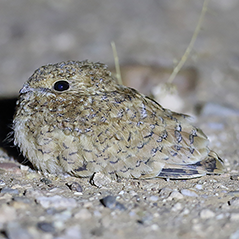
On this tour we travel deep into the Sahara Desert to a comfortable house in Aousserd to look for the recently-discovered Golden Nightjar. Other target birds here include Black-crowned Sparrow-lark, Dunn’s Lark, Cricket Longtail, Fulvous Chatterer and Desert and Sudan Golden Sparrows, whilst at an oasis we should find both Crowned and Spotted Sandgrouse. At the coast we will look for Great (White-breasted) Cormorant, Lesser Crested and West African Crested Terns and possibly Kelp Gull, all within the Western Palearctic.
Day 1 Mid-morning flight from London Gatwick via Casablanca to Dakhla, where we arrive in the late evening and spend the next two nights in a comfortable hotel.
Day 2 Today we will spend the whole day around Dakhla looking for speciality birds. Seawatches on the seaward side of the Dakhla peninsula may produce Cory’s Shearwater, Northern Gannet and Great Skua; on our 2016 tour both Band-rumped and European Storm-petrels were seen. If the sea is calm, a scan over the sea for cetaceans could be productive as there is a chance of the critically endangered Atlantic Humpback Dolphin. Great (White-breasted) Cormorants can be found in small numbers here but the taxonomy is still uncertain as to whether they are Moroccan or White-breasted. We will then visit the bay to check the state of the (unpredictable) tide to see how far out we will need to walk to scan the gulls and terns. Our targets here are Lesser Crested and Western African Crested Terns in amongst the huge numbers of mainly Lesser Black-backed and Yellow-legged Gulls with smaller numbers of Audouin’s and Slender-billed Gulls. Other terns may include Sandwich and Little. We should check the gulls carefully as Kelp Gull is also possible here, and by carefully checking any small gulls we may even find something outrageous like Grey-hooded Gull. In March 2017 a White-throated Bee-eater was seen outside a local hotel. Overnight Dakhla.
Day 3 Taking packed breakfasts with us; we will begin the long journey inland towards Aousserd on a decent road, stopping at either a private site or Gleb Jdiane to watch sandgrouse coming in to drink. In the mornings, Crowned Sandgrouse is the most likely species, but smaller numbers of Spotted Sandgrouse can occur. Other birds in the area include Thekla’s Lark, Great Grey Shrike and Red-rumped Wheatear; in 2016 an Allen’s Gallinule was found here, and anything can turn up on migration. Closer to Aousserd we will start our search for Cricket Longtail. This enigmatic species is right on the edge of its Western Palearctic range here, although it is quite common in the right habitat. Cream-coloured Courser, Brown-necked Raven, African Desert Warbler and Desert and White-crowned Wheatears are also present. Black-crowned Sparrow-lark can often be found, while another speciality that can occur is Dunn’s Lark; both species are irruptive, however, and are easier to see in some years than in others. Other larks can include Greater Hoopoe-lark and Bar-tailed, Desert and Thick-billed Larks whilst the crested-type larks in the area may actually be the Maghreb race of Crested Lark. Desert Sparrows are much commoner here than in their former stronghold of Merzouga as are Fulvous Chatterers. Sudan Golden Sparrow can be found in the Desert Sparrow flocks and seven were seen on our 2019 tour, although they are irruptive depending on whether it has been a wet winter. We will spend the next two nights camping with meals prepared for us.
Day 4 We will have the whole day (and night) continuing our search for speciality birds of the area and, with this amount of time, who knows what we may discover in this little-birded region, as Blue-naped Mousebird has been recorded slightly farther south in Mauritania, so you never know your luck! Golden Nightjar (recently discovered breeding in the Western Palearctic) is our main target during the night although we may be lucky and find one at daytime roost. We may have to travel a long way off road in our 4 x 4 vehicles to remote Oueds as the Golden Nightjars move sites from year to year; in 2019 we found our birds over 60 km from the road! A large variety of migrants pass through the desert and in the acacias in the Oueds we may see Western Orphean Warbler, Western Bonelli’s Warbler and European Bee-eaters whilst Barn Swallows pass through on a broad front together with raptors such as Booted Eagle and Western Marsh Harrier. During the day we will also visit a variety of sites where Lanner Falcon and Pharaoh Eagle-owl breed. A variety of animals may be seen during our night drives and these may include Fennec and Rüppell’s Foxes, Golden Wolf, Sand Cat, Lesser Egyptian Jerboa, Desert Hedgehog, Cape Hare, Horned Viper, Fat-tailed Gerbil and Spiny-tailed Lizard.
Day 5 We will leave Aousserd this morning to begin the 267-kilometre drive back towards Dakhla (birding en route of course) looking for species we may still need and arriving in the evening where we will spend the last night of the tour. Overnight in Dakhla.
Day 6 We will take an early breakfast and drive the short distance back to Dakhla Airport for our journey back to London Gatwick, again via Casablanca, arriving mid-afternoon.
General Information The climate can vary from warm in the desert to cool on the coast. Rain is unlikely (it rains, on average, three days a year!) but strong winds are a feature of this area and we may encounter sandstorms. There will be a moderate amount of walking, mainly on flat (but sandy) ground. Insects are not a problem. Visas are not required for EU citizens. Accommodation standards for the three nights at the coast are good, with en suite facilities. We will be camping for two nights in the desert with shared toilet/wash tent.
Group size Minimum number for tour to go ahead: 6; maximum group size: 10 with 1 leader.
 Currency converter